
The Meta ads minimum daily budget in 2026 depends on your campaign settings. Meta's minimum-budget guidance does not give one dollar amount that applies to every advertiser. Ads Manager alerts you when your budget falls below the requirement for your setup; it may also recommend more even when you meet that minimum.
Start by checking what your campaign requires. Then calculate what your available money can realistically test. Finally, check how much Meta can spend on an individual day: entering $20 as a daily budget does not necessarily limit that day's spend to $20.
What is the minimum daily budget for Meta ads in 2026?
Meta's minimum-budget guidance says requirements and recommendations depend on your business vertical, budget type, buying type, bid strategy, optimization, currency, and schedule. Minimums can also vary by country and objective.
That makes a universal "$1 for awareness, $5 for conversions" table an unreliable way to determine your own requirement. Those figures are not established as universal minimums by this guidance.
Three budget decisions need separate answers:
| Decision | What it tells you | Where to start |
|---|---|---|
| Platform minimum | Whether the entered budget meets your setup's requirements | The alert in Ads Manager |
| Practical starting budget | Whether the money could support the question you want to test | Your estimated cost per result, desired volume, and affordable total |
| Spending limits | How much spending is permitted over a day or week | Budget settings, sharing status, and Meta's spending rules |
Meeting the first requirement does not establish that the campaign will produce enough leads or sales to judge its performance. Conversely, a recommended increase does not necessarily mean your existing budget is below the required minimum.
How to check the minimum for your campaign setup
Check the budget alongside the settings it belongs to. Before comparing your number with someone else's, identify:
- Account currency and location. Meta's guidance uses US-dollar examples and notes that requirements can differ by country.
- Budget level and duration. Is this a campaign budget or an individual ad-set budget? Are you using a daily or lifetime budget?
- Optimization event. What action is Meta trying to achieve, such as a purchase or landing page view?
- Bid strategy. Are you using a cost per result goal or another approach?
- Schedule. When will the campaign or ad set run?
Then inspect the budget message in Ads Manager. An alert that the budget does not meet requirements calls for a different response from a recommendation that more budget could improve results. Keep the message and settings together when diagnosing the issue.
Using a cost per result goal? Check the five-times recommendation
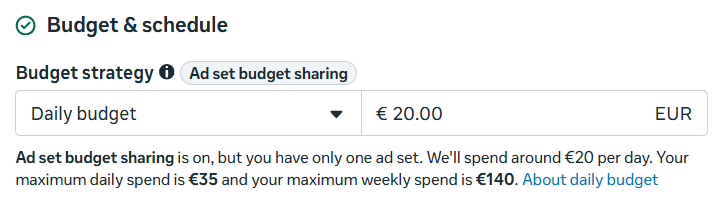
Meta recommends a daily budget of at least five times your cost per result goal when you use that bid strategy. Its example is a $5 cost per result goal with a daily budget of at least $25.
This recommendation applies to that setup. It is not a universal $25 minimum, and setting a $5 goal does not establish that your actual results will cost $5 each.
Use the goal to express what you want to pay. Use observed results, or clearly labelled assumptions when you have no history, to plan how much a test might cost.
How to calculate a practical Meta ads starting budget
A useful starting budget connects the result you want with a total you can afford. Work out the total first, then translate it into a daily planning amount.
Estimate the cost of the result you actually need
Choose a result that answers the business question. If you need inquiries, count relevant leads; cheap clicks alone cannot tell you the cost of acquiring those leads.
If you have comparable campaign history, calculate spend divided by results over a stated period. Treat that as a planning input rather than a promise that the next campaign will behave the same way. If you have no history, use an explicit assumption and check how the calculation changes when that assumption is wrong.
The planning formula is:
Assumed cost per result × desired results ÷ test days = average daily allocation
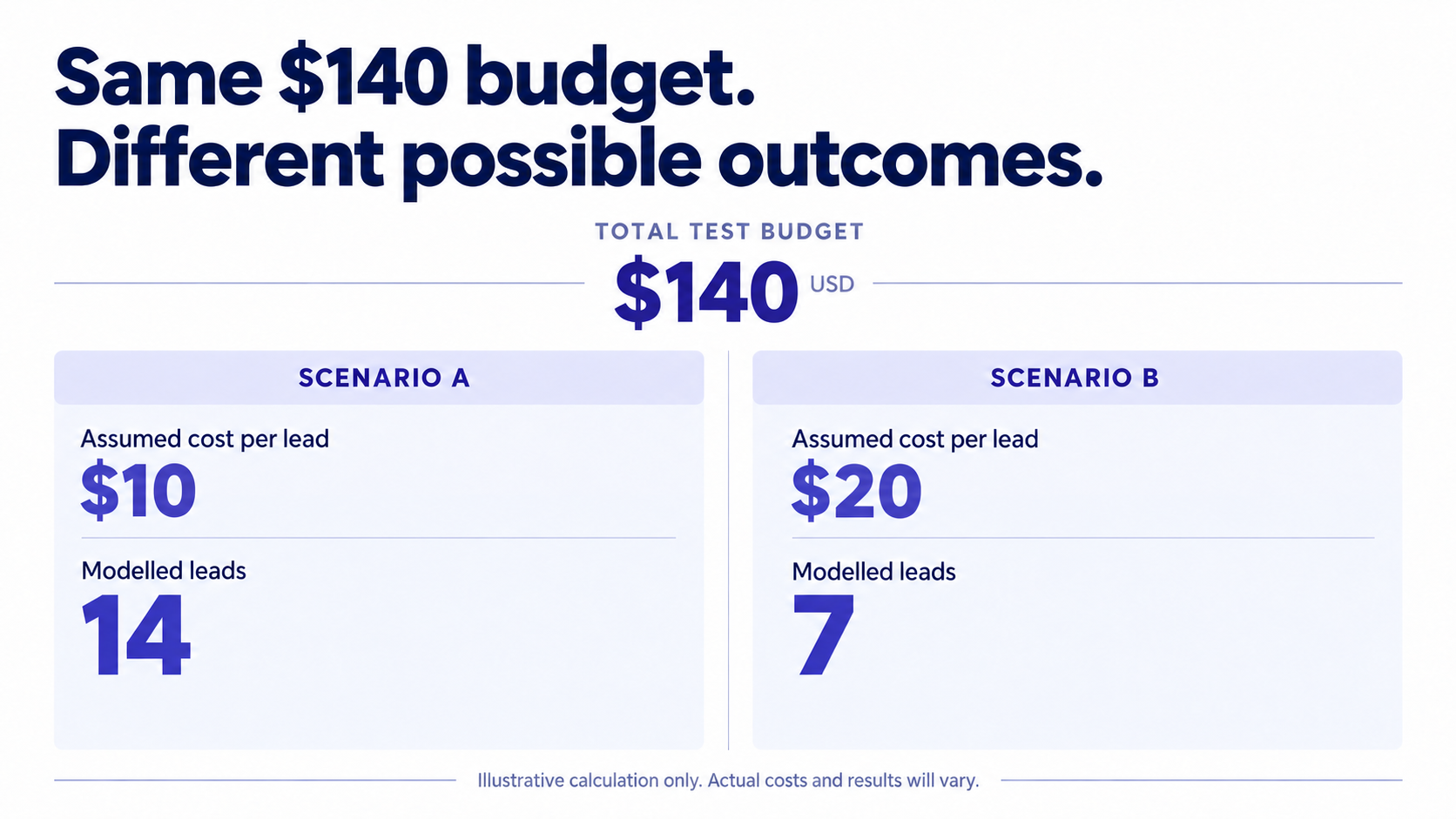
For a hypothetical lead-generation test:
- Assumed cost per lead: $10.
- Desired volume: 14 leads.
- Test period: 7 days.
- Modelled total: $140, or $20 per day on average.
If leads cost $20 instead, the same $140 models seven leads. It does not buy fourteen simply because that was the target. Neither scenario is an industry benchmark, a Meta minimum, or a forecast. Seven days is the example's planning period, not a claim that every campaign can be evaluated in a week.
Decide what you can afford to learn
Choose your maximum affordable test spend before launching. Then write down the decision the test should inform: whether an offer generates qualified inquiries, for example, or whether a landing page turns visits into inquiries.
If the affordable total is too small for the volume you wanted, narrow the question. Testing one offer is easier to interpret than dividing the same money among several offers and audiences. You can also accept that the first test will provide limited evidence. Increasing the budget is only an option if the business can afford it.
Keep this calculation separate from the spending settings. The $20/day figure above is an average planning amount; the next section on spending flexibility explains why it is not a strict daily cap.
What can you test with $5, $10, or $20 a day?
First check whether the amount meets your configuration's requirement. If it does, the next question is how much evidence your total can buy.
| Average daily allocation | Planned spend over seven days |
|---|---|
| $5 | $35 |
| $10 | $70 |
| $20 | $140 |
These are arithmetic totals, not guaranteed spending or result counts. As a daily-budget illustration, they assume a full Sunday-to-Saturday week, no budget changes, and no ad-set budget sharing.
At an assumed $10 per lead, a $35 allocation does not even model four leads. That may be enough to uncover an obvious problem, but a few outcomes can leave considerable uncertainty about future performance. At $140, the same assumed cost models fourteen leads; it still does not guarantee that those leads will be qualified or profitable.
For a small test:
- Choose one main question. For example: does this offer generate inquiries from the people we want to reach?
- Keep the comparison manageable. Avoid splitting a small total across so many variations that each receives very little spend.
- Check that the chosen action is being recorded. Otherwise, a lack of reported results is difficult to interpret.
- Set an affordable review point. Decide what spending level will trigger a review rather than increasing spend simply because the first few results disappoint.
A smaller budget can support a narrower question. It does not make a cheaper action equivalent to the business result you wanted: optimizing for landing page views may require less budget than purchases, but page views do not demonstrate profitable sales.
How daily spending flexibility and budget sharing affect your spend
Meta describes a daily budget as a spending target across a calendar week running from Sunday through Saturday. Spending can be higher on some days and lower on others.
An unchanged daily budget can spend up to 75% more on one day
Without ad-set budget sharing, Meta states that daily spending can reach 175% of the daily budget, while weekly spending is limited to seven times the daily budget.
For an unchanged $20 daily budget over a full calendar week, that means up to $35 on an individual day and $140 over the week. A day at $35 does not, by itself, mean Meta ignored the budget. It used part of the week's allocation sooner.
This distinction matters when you can afford $140 across a week but cannot comfortably absorb $35 on a particular day. Check the permitted spending pattern before choosing the daily amount.
Ad-set budget sharing changes the individual ad set's limits
Meta's own example uses an unchanged $100 daily budget:
| Budget-sharing setting | Maximum on an individual day | Maximum over a full calendar week |
|---|---|---|
| Off | $175 | $700 |
| On | $210 | $840 |
These are the stated limits for the example, not expected spend. Check sharing status before applying the simpler 175% daily and seven-times weekly calculation to an individual ad set.
Mid-week starts and budget changes need different calculations
Meta says that starting an ad set or changing its daily budget mid-week leads to prorated spending for the remaining week, with an additional flexibility margin of up to 25% of the daily budget. Do not apply the unchanged full-week example to those situations.
Lowering a daily budget late in the day also cannot undo money already spent. Meta warns that delivery may have too little time to adjust to the lower amount.
If you need to stop further delivery, you can pause the ad in Ads Manager. A bill received afterward can still relate to charges accrued before the ad stopped running.
Why Meta says your budget is too low
Start with the actual message instead of increasing the budget by an arbitrary amount.
| What you see | What to check next |
|---|---|
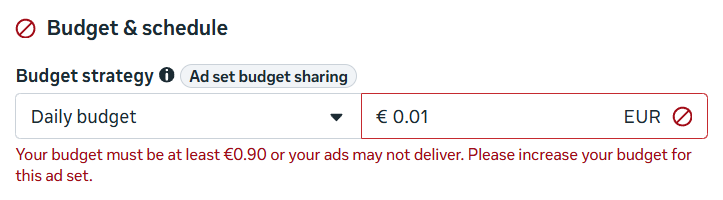
| An alert that the budget fails minimum requirements | Check the requirement against your currency, budget type, schedule, optimization, and bid strategy. |
| A recommendation to increase a budget that meets the minimum | Compare the suggested allocation with your affordable total and the volume you want to test. |
| A recommendation while using a cost per result goal | Review Meta's five-times guidance for that strategy; do not assume the goal is your actual cost. |
| Trouble lowering a lifetime budget | Check accrued spend and Meta's rule for the minimum new lifetime amount. |
For the last case, Meta says the new lifetime budget must be at least spend to date plus 10% of spend over the past two days. If $300 has been spent and $100 of that was spent in the last two days, the minimum new amount in its example is $310. That is a rule for editing an existing budget, not a minimum required to launch a campaign.
If the budget is accepted but results disappoint, widening it may not resolve the issue. Review whether the offer, destination, and recorded results answer the question you set out to test before committing more money.
Frequently asked questions
Is the Meta ads minimum budget per campaign, ad set, or ad?
Meta's minimum-budget guidance refers to campaigns and ad sets. Daily budgets can be set at campaign level through Advantage+ campaign budget or for individual ad sets. Check the level at which you entered the budget; do not automatically multiply a campaign's daily amount by its number of ads.
Does a $5 cost per result goal mean I can spend $5 per day?
Meta recommends at least $25/day for a $5 cost per result goal. The goal is a bidding input, not a daily spending allowance or a guarantee of $5 results.
Does a boosted post use the same budgeting setup?
Do not assume that a requirement seen in one promotion workflow applies unchanged to another. Check the budget requirement in the setup you are using. For the separate question of budgeting for several posts each month, see our guide to how much it costs to boost a post.
Apply your budget consistently when promoting posts
Once you have chosen a budget, recurring post promotion introduces another decision: which posts should receive it?
Boosterberg automates Facebook and Instagram post promotion using customer-defined rules, including engagement thresholds, content filters, budgets, and stop conditions. Campaigns run in your own Meta Ads Manager account. You decide the strategy; the rules handle recurring execution.
See how automated post boosting works, or start a trial if that workflow fits your needs. Meta's budget requirements still apply.