
To understand how to scale Facebook ads, start with the result you can afford to buy. Check that your campaign produces purchases or qualified leads at an acceptable cost, choose a budget increase or a specific expansion test, and review the results before adding more money.
The next decision is to scale, hold, or fix a problem. More purchases can still leave you with less money after advertising costs. A lower cost per lead can hide a higher cost per qualified inquiry. Your scaling plan needs to catch both.
What does scaling Facebook ads mean?
Scaling Facebook ads means expanding advertising to generate more of the results your business wants while keeping the economics acceptable. Raising the budget is one way to pursue that goal. You can also test additional creative, placements, audiences, or markets.
Advertisers commonly describe these approaches as vertical and horizontal scaling:
| Approach | What you change | Question it should answer |
|---|---|---|
| Vertical scaling | Increase the budget on an existing campaign or ad set | Can this setup produce more useful results at a cost we can accept? |
| Horizontal scaling | Test additional creative or suitable ways to reach people | Can another message, format, audience, placement, or market support growth? |
Neither method guarantees that the next result will cost the same as the last one. Set a business target you can evaluate: more customers within an acquisition-cost limit, for example, or more qualified inquiries your sales team can handle.
Check whether your winning ad set is ready to scale
Define the result and cost you can accept
Start with what remains from a sale after its variable costs. This is its contribution before advertising: revenue minus costs such as the product, payment fees, fulfilment, and expected returns.
For a hypothetical order with $100 in revenue and $60 in variable costs, $40 remains before advertising. Spending all $40 to acquire that order leaves nothing from it for fixed overhead or profit. If you want to retain $15, the acquisition-cost target in this simplified example is $25.
That target is specific to the assumptions. Discounts, returns, repeat purchases, and different product margins change the calculation. Avoid paying for expected future purchases unless you have evidence and can afford the wait.
For lead generation, define what qualifies as a useful lead and follow those leads through to customers. A completed form and a sales opportunity are different results. Decide which one will justify increasing spend.
Check the evidence behind the winner
Before scaling a winning ad set, check:
- The outcome. Does it produce the purchase or qualified inquiry you need, or mostly clicks and engagement?
- The amount of evidence. Is the result consistent across relevant periods, or driven by a few purchases on one unusually good day?
- The reporting window. Have people had enough time to convert and your team enough time to qualify leads?
- The measurement. Are you comparing the same conversion definition and attribution settings, and do business records support the reported direction?
- The ability to deliver. Can stock, checkout, fulfilment, and sales follow-up support more demand?

Choose a baseline that reflects normal trading conditions. A promotion, stock shortage, or holiday can make two periods poor comparisons even if they contain the same number of days.
Measurement definitions also matter. In March 2026, Meta announced changes to how it classifies link-click and other interaction-based attribution, with a staged rollout. When comparing older and newer reports, check whether their definitions are consistent before treating a difference as a performance change. Meta's measurement announcement
Choose the Facebook ads scaling strategy that fits the constraint
Increase the budget when the current setup has room
A budget increase is a reasonable test when results meet your business target, reporting is sufficiently complete, and you can afford the additional exposure. First identify where the budget is set.
If you use a campaign budget, review the campaign's total spend and results when assessing the increase. Do not judge the whole change only by your favourite ad set. If you use ad-set budgets, review the affected ad set alongside the campaign and account totals. Check whether any budget-sharing settings affect its allocation.
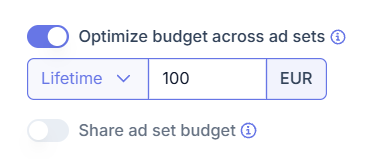
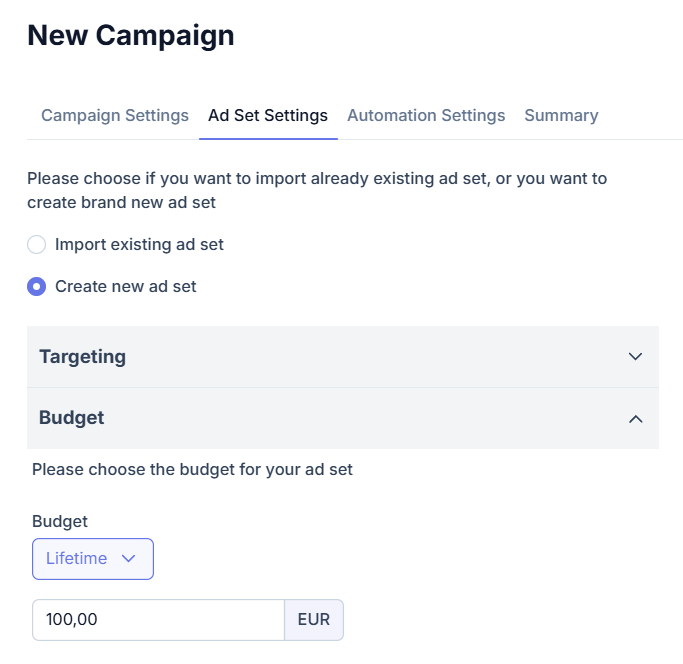
Keep the business question in view. You may need separate spending decisions for different services or markets. You may instead care about the combined result from a campaign. Those are different reasons for choosing a structure; neither requires moving every winner into a new campaign.
Meta includes account simplification among its Performance 5 priorities. Use that as a reason to question unnecessary complexity, not as a rule that every business should run the same number of campaigns or ad sets.
Test new creative or reach when spend alone is not the answer
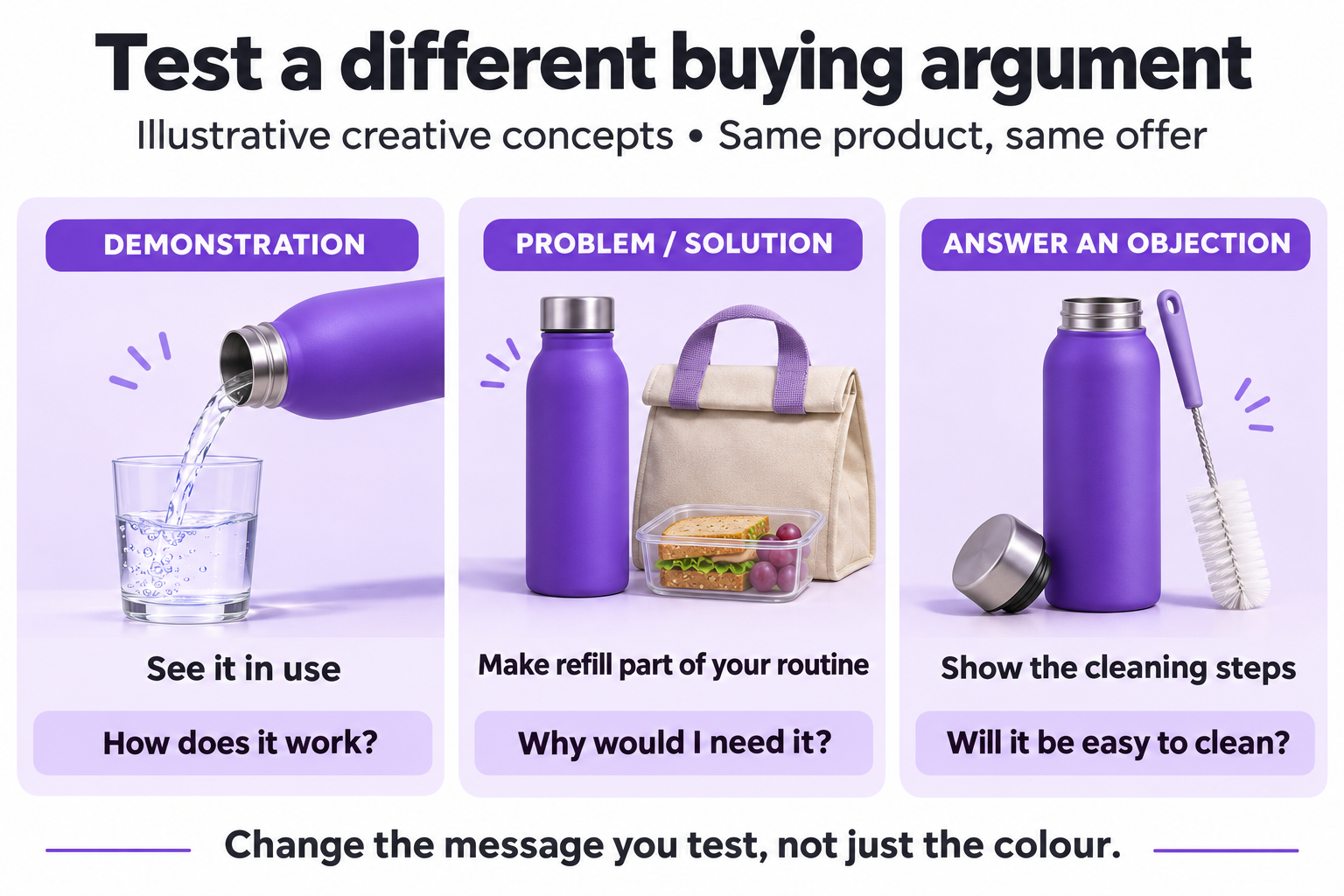
Choose a test that addresses an observed limitation. If the current ad explains one benefit, try a distinct concept that answers another buying concern. A product demonstration, for example, can test whether showing how something works is more persuasive than describing its features.
Meta also includes creative diversification in Performance 5. For your test, specify what is different and why it might matter. Producing several minor colour changes does not answer the same question as testing a demonstration against a customer story.
| What you observe | A useful next test or check | Tradeoff to consider |
|---|---|---|
| Business results meet target and there is no known delivery bottleneck | A bounded increase to the existing budget | More spend may change the cost and mix of results |
| One message accounts for most results | A distinct concept addressing another customer concern | New creative needs its own evaluation budget |
| Current reach is deliberately limited | Another relevant audience, placement, or serviceable market | Suitability, assets, language, and fulfilment may differ |
| Plenty of visits but weak purchase completion | Check the offer and buying experience before expanding | More reach will not identify a broken checkout for you |
Duplicating a winning ad set can help you prepare a separate test. It does not establish that the copy will reproduce the original's performance. Before creating it, write down what it will test and why that needs separate structure. Identical copies alone do not demonstrate new demand.
Make a controlled budget increase
Write down the change before making it. A percentage sounds manageable until several increases accumulate without a review.
- Record the baseline. Save the period, spend, result count, cost per result, attribution basis, and relevant business outcome.
- Choose an affordable test size. Translate the proposed increase into money and consider the total you could spend while evaluating it.
- Set two review triggers. Decide when results should be mature enough to assess, and what spending or operational problem requires earlier action.
- Make one main change. Avoid changing budget, audience, offer, and creative together if you want to understand the result.
- Review before repeating. Do not schedule the next increase merely because a day has passed.
For illustration, moving a daily budget setting from $100 to $120 is a 20% increase. Moving it from $1,000 to $1,200 is also 20%, but the nominal increase is $200 rather than $20. These are changes to budget settings, not promises about actual daily spend. Check the spending information shown for your setup and our guide to Meta budget requirements and spending controls.
You will often encounter the suggestion to increase budgets by 20% at a time. Treat it as a possible test size, not a guarantee of stable results or protection from learning changes. Use the current guidance in your account, your conversion timing, and the amount you can afford to evaluate. A percentage cannot replace those decisions.
If buyers usually take several days to purchase, tomorrow's report may be too early to judge today's change. You should still monitor spend and obvious failures during that wait. Waiting for complete results does not require leaving a broken checkout or unaffordable spending running.
Use a short decision record for each change:
| Record | What to enter |
|---|---|
| Objective and limit | Desired business result, acceptable cost, and affordable additional exposure |
| Baseline | Dates, spend, outcomes, attribution basis, and relevant business records |
| Change and reason | The setting or test you will change and the question it answers |
| Review conditions | When results should be sufficiently complete and what triggers earlier action |
| Outcome and next decision | What changed, what remains uncertain, and whether to scale, hold, or repair |
This record also gives an agency and its client a shared basis for discussing the next budget move.
Decide whether to scale again, hold, or repair
More conversions can still be a worse result
Cost per acquisition, or CPA, divides advertising spend by the acquisitions being counted. Here, we use purchases. The average is useful, but compare it with the total contribution remaining after advertising as well.
Consider this hypothetical USD example. Assume equal-length periods, consistent purchase definitions, sufficiently complete reporting, and $40 contribution per order before advertising.
| Metric | Before expansion | After expansion |
|---|---|---|
| Actual spend | $1,000 | $1,500 |
| Purchases counted | 40 | 50 |
| Average cost per purchase | $25 | $30 |
| Contribution before advertising | $1,600 | $2,000 |
| Contribution after advertising, before fixed overhead | $600 | $500 |
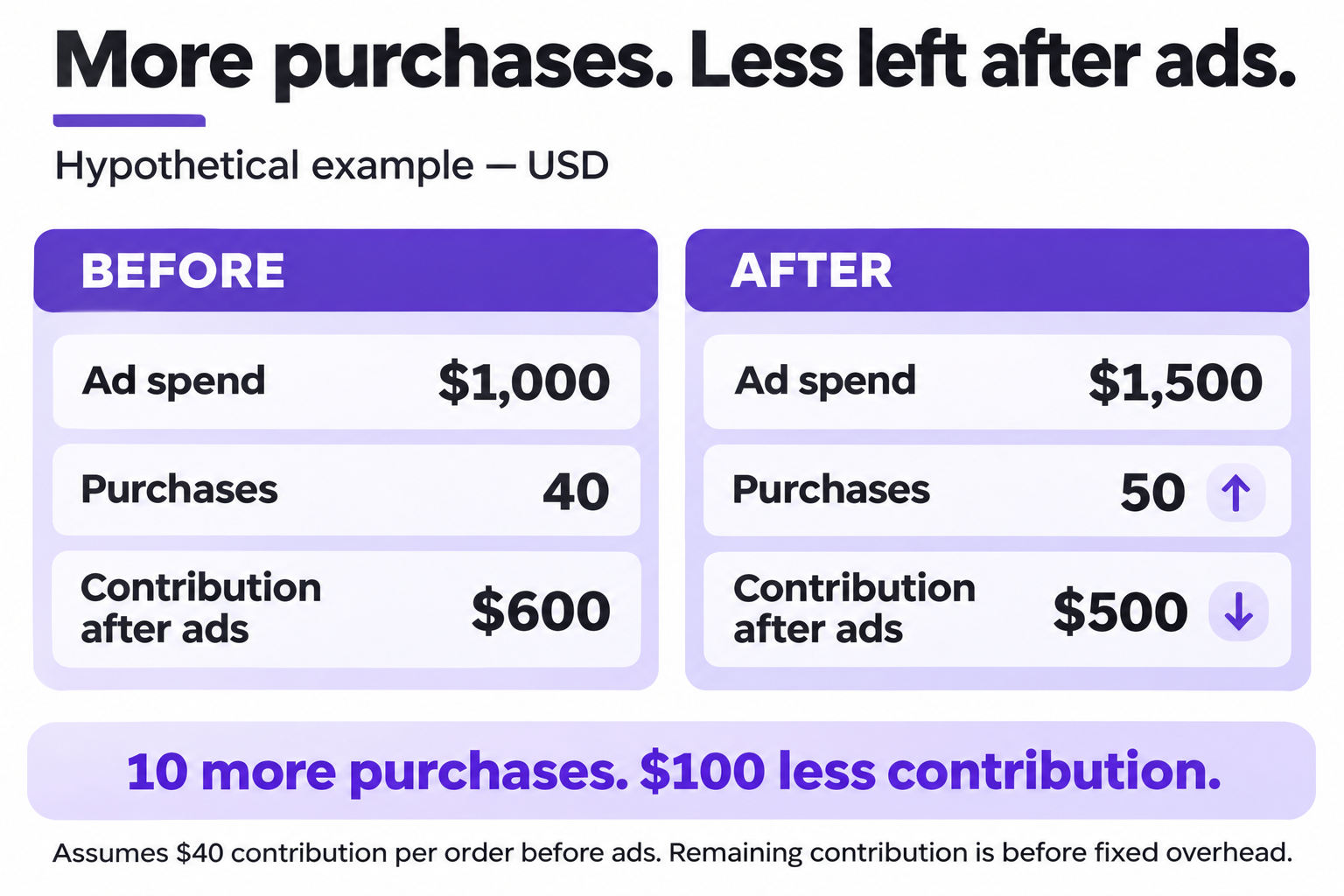
Purchases increased, and the $30 average CPA remains below the assumed $40 contribution per order. Yet the amount left after advertising fell by $100.
The additional $500 in observed spend accompanied ten additional purchases: $50 per additional observed purchase. That deserves investigation before another increase.
This is a before-and-after diagnostic, not proof that the budget change caused those ten purchases. Other marketing, demand, timing, and measurement can affect the comparison. If the purchase difference is zero or negative, do not calculate a positive cost per additional purchase.
For a causal question, what happened because of the advertising, Meta identifies incrementality experiments such as Conversion Lift as a measurement approach. A before-and-after calculation does not replace that kind of experiment. Meta's guidance on measuring advertising impact
Lead generation needs the same discipline. Suppose $600 produces 30 leads, of which 12 qualify. That is $20 per lead and $50 per qualified lead. After expansion, $900 produces 60 leads but still only 12 qualify. Cost per lead improves to $15, while cost per qualified lead rises to $75.
These are hypothetical figures, not benchmarks. Apply the same qualification criteria and allow the same follow-up time in both periods. Then check whether qualified leads become customers.
Find the problem before choosing the fix
Use the evidence to choose the next action:
| What the evidence shows | Decision | Next action |
|---|---|---|
| More useful results within the business target, with no known capacity problem | Consider scaling again | Choose another affordable increase and record a new review point |
| Too few mature results to judge | Hold further increases | Reassess when reporting and qualification are sufficiently complete; keep monitoring exposure |
| Cost or contribution has worsened beyond the agreed limit | Stop expanding and diagnose | Review the change, business records, and the likely constraint before deciding on a reduction or pause |
| Checkout, tracking, or lead handling has failed | Repair and control exposure | Address the failure; pause affected delivery when continued spending is unjustified |
Use supporting metrics to narrow the investigation. Rising frequency alongside falling click-through rate is a reason to investigate creative fatigue, not proof of it. More expensive impressions warrant checking changes in placement, audience mix, and auction conditions. Similar traffic with fewer purchases warrants checking the offer, landing page, checkout, and tracking.
Also separate what happened after a change from what the change caused. Changing one main variable makes interpretation easier, but demand and other campaigns can still move at the same time.
If you reduce a budget, money already spent remains spent. Treat the reduced setting as another change to monitor rather than assuming the previous performance will return immediately.
Use Boosterberg for recurring post promotion
Boosterberg automatically promotes qualifying published Facebook and Instagram posts through campaigns in your own Meta Ads Manager account. You define the selection criteria and promotion controls, including engagement thresholds, time windows, content filters, budgets, and stop conditions.
That fits a recurring job within a wider advertising strategy: applying your promotion criteria across the content your team publishes. For example, you can define which posts qualify for paid support, how much support to give them, and when promotion should stop. Our guide to how automated post boosting works explains the workflow.
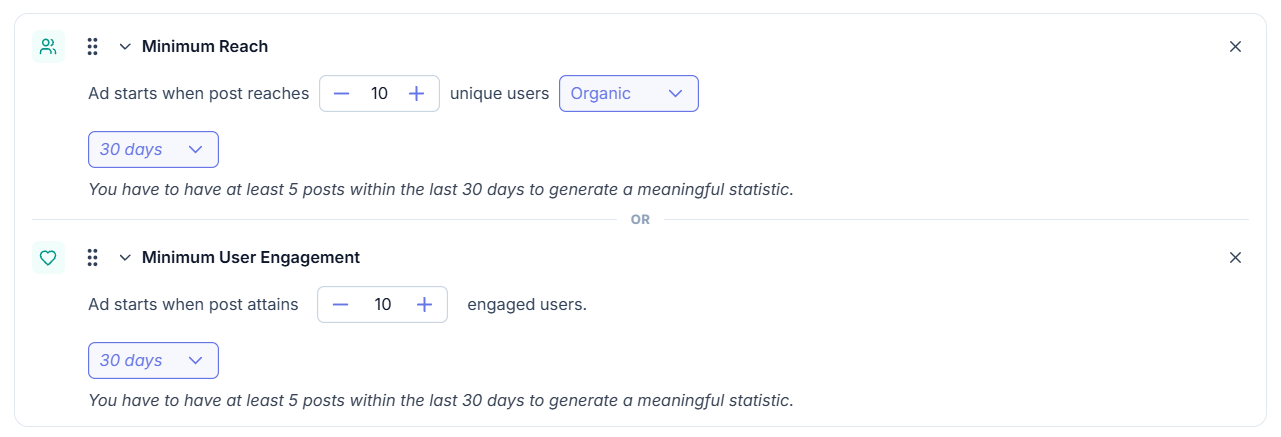

The paid result still needs evaluation. A post with strong organic engagement may be worth testing, but those reactions do not establish an acceptable purchase or qualified-lead cost. Use the campaign's actual objective to assess it.
Boosterberg automates recurring promotion within the rules you choose. Your team remains responsible for deciding whether the broader advertising programme should receive more budget, change direction, or stop expanding.
If applying those decisions across your published posts is the recurring work you want to automate, start your 14-day Boosterberg trial. No credit card required.
Frequently asked questions
How quickly can I increase my Facebook ads budget?
Choose the next review around your conversion timing, the amount of evidence available, and your spending limit. A fast review is useful for spotting failures; it may be too early to judge sales performance. Avoid stacking increases before you can assess the previous one.
Should I duplicate a winning ad set or increase its budget?
Increase the existing budget when your question is whether the current setup can support more spending. Consider a separate test when you have a distinct reason, such as a new market or offer. A duplicate does not prove that the original's performance will transfer.
Can a campaign be worth scaling if ROAS falls?
Yes, depending on the economics. Return on ad spend, or ROAS, is attributed revenue divided by advertising spend. It does not subtract product and fulfilment costs. A lower ROAS can accompany greater total contribution after advertising; judge that contribution, customer quality, and cash requirements before deciding.
Does strong organic engagement mean a post is ready for sales-focused paid promotion?
It can justify a test, but it does not establish that people will buy. Check whether the post has a relevant offer and destination, then evaluate its paid purchases or qualified leads. If the objective is engagement itself, assess that objective without presenting it as evidence of sales.